Episode notes
Three markings you can use immediately
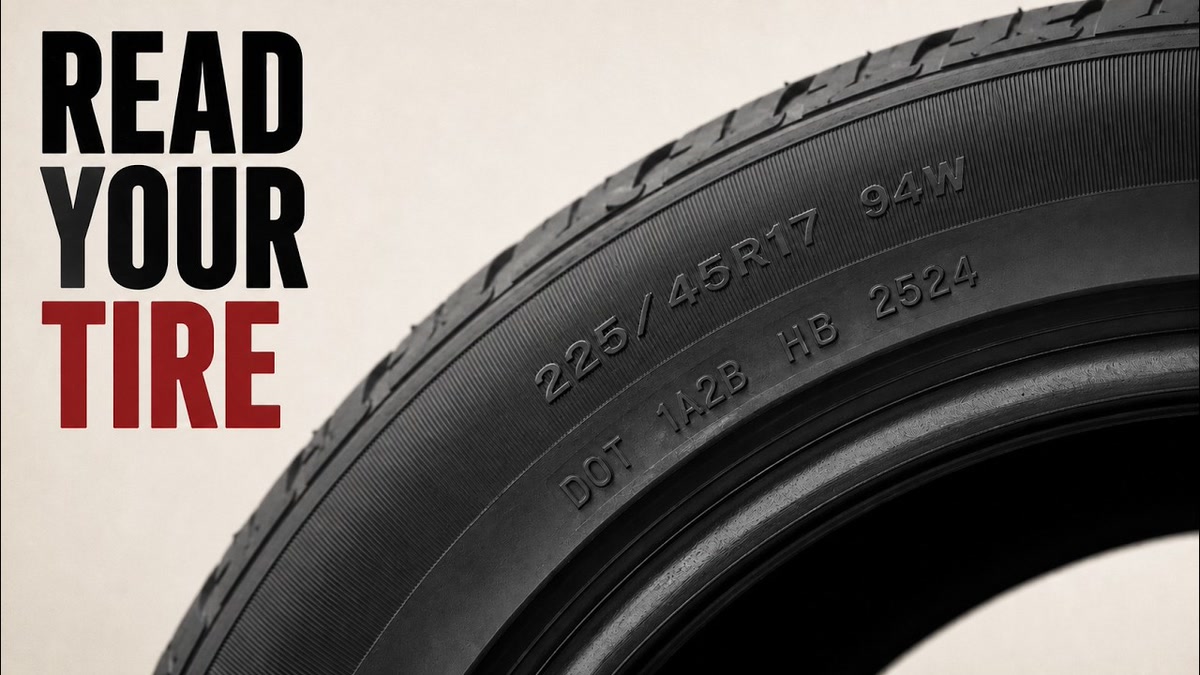
The final four digits of a modern U.S. tire identification number state the week and year of manufacture. A code ending in 2524 means week 25 of 2024. Age is not the only measure of serviceability, but Michelin recommends annual professional inspection after five years of use and replacement by ten years from manufacture as a precaution.
The pressure molded into the sidewall is a maximum value for the tire, not the normal pressure selected for a particular vehicle. NHTSA directs drivers to the Tire and Loading Information label or the owner's manual for the recommended cold inflation pressure.
Raised treadwear bars provide a built-in wear reference. NHTSA states that a tire should be replaced when the tread becomes level with those indicators at 2/32 inch, approximately 1.6 millimetres.
225/45 R18 95Y is six answers, not one number
In a common metric size, 225 is nominal section width in millimetres. The aspect ratio 45 means the sidewall section height is 45 percent of that width. R denotes radial construction, and 18 is the wheel-rim diameter in inches. The service description follows: 95 is a load index associated with a maximum load, while Y is the speed symbol.
These values must be matched to the vehicle specification. Prefixes such as P and LT distinguish passenger and light-truck sizing systems; XL denotes an extra-load tire.
The sidewall is not one code. It is a set of answers to different engineering, safety, and fitment questions.
Weather marks and mounting instructions do different jobs
M+S is a mud-and-snow marking. The Alpine or Three-Peak Mountain Snowflake symbol identifies a tire that meets a defined severe-snow performance requirement. The two marks should not be treated as equivalent evidence.
A directional tire carries an arrow showing its intended forward rotation. An asymmetric tire identifies which side must face outward. Some designs combine both requirements.
DOT identifies the tire; UTQG compares three test areas
In the United States, DOT precedes the tire identification number. Federal rules define the information encoded in that number, including the manufacturing-date segment, so tires can be identified for compliance and recall purposes.
Where applicable, Uniform Tire Quality Grading places three grades on passenger-car tire sidewalls: treadwear, traction, and temperature. Treadwear is comparative under a specified test, not guaranteed mileage. Traction describes straight-ahead wet braking on specified surfaces. Temperature describes heat resistance under controlled testing.
Smaller clues include OE codes such as MO, AO, BMW's star, Porsche N codes, and Tesla T codes. Run-flat systems use manufacturer-specific labels such as RFT or SSR. Other markings identify whether the tire is tubeless, its ply materials, maximum load, construction, and regional approval.
Questions behind the markings
Where is the tire manufacturing date?
On modern tires using the U.S. TIN format, the final four digits give the week and year of manufacture.
Should I inflate the tire to the pressure printed on its sidewall?
No. Use the vehicle manufacturer's recommended cold pressure on the placard or in the owner's manual.
Does a higher UTQG treadwear number guarantee more miles?
No. It is a comparative test grade; real wear varies with use, maintenance, roads, and climate.
Are M+S and 3PMSF the same?
No. The Alpine symbol is tied to a defined severe-snow performance test; M+S alone is a different marking.
Sources
Electronic Code of Federal Regulations. 49 CFR § 574.5 — Tire identification requirements.
U.S. National Highway Traffic Safety Administration. Tire Safety Ratings and Awareness.
U.S. Government Publishing Office. 49 CFR § 575.104 — Uniform tire quality grading standards.
U.S. Tire Manufacturers Association. Tire Care & Safety Guide.
Michelin North America. How to Read Tire Markings and Sidewall Codes.
Michelin North America. When to Replace Tires.
Michelin North America. What Are Michelin-Developed Marked Tires?.
United Nations Economic Commission for Europe. Snow-performance markings and 3PMSF.
Michelin North America. Directional and asymmetric tire guidance.
Continental Tires. SSR Runflat Technology.